
In every journey back, landmarks become portals; crossing one of these, we slip through into a field of energy that can range anywhere from familiar to atavistic – even before reaching our destination, we arrive home.
I was passing through one such portal in the passenger seat of Ramu Mama’s Maruti 800 as we rounded about the SKM Jallikattu statue in Erode city. Two figures frozen – a muscly mustachioed man in a lungi and a headwrap with his arms wrapped around a muscly menacing bull – in capture, the line between violence and romance thins.
We pulled up behind a small lorry full of some verdant, leafy crop with two farmers, wrinkled from age and sun and toil, lounging atop and amidst the fronds. Framed by the windshield and by the catharsis of being back, it featured like a painting in motion. I felt a strong (habitual?) impulse to capture the moment, but hesitated to whip out my camera. I’d been to India many times before, but for the first time in my life, I was visiting without either of my parents. After 30 years, my experience was newly unmediated and activated a greater sense of responsibility in each of my movements and interactions, which was dignifying, liberating; it was also giving me a case of Limp Shutter Finger.
I unzipped the front pocket of my backpack and readied my grip, questioning my own hesitation, when one of the farmers shifted his gaze, looking right back at me. Unholster phone, aim, frame, point & SHOOT [CAPTURE]. I retracted my hand, my hesitation melted away. Our eye contact held steady; both of us just looking, our complicity feeding our dignities.
The looking lasted a long moment, passing when the lorry peeled off, and Mama and I were the only ones left traveling down the road to Chavadipalayam.
“To take a photograph is to participate in another person’s mortality, vulnerability, mutability.”
— Susan Sontag, ‘On Photography’ (1977)
“The best things on television are its junk, and no one and nothing is seriously threatened by it. Besides, we do not measure a culture by its output of undisguised trivialities but by what it claims as significant. Therein is our problem, for television is at its most trivial and, therefore, most dangerous when its aspirations are high, when it presents itself as a carrier of important cultural conversations… Television, in other words, is transforming our culture into one vast arena for show business. It is entirely possible, of course, that in the end we shall find that delightful, and decide we like it just fine. That is exactly what Aldous Huxley feared was coming, fifty years ago.”
- Neil Postman, ‘Amusing Ourselves to Death: Public Discourse in the Age of Show Business’ (1985)
“Ordinary persons frequently adopt some expression, which they apply at every opportunity… to all manner of suitable or unsuitable objects. In one respect this is a group fashion, yet in another respect it is really individual, for its express purpose consists in having the individual make the totality of his circle of ideas subject to this formula. Brutal violence is hereby committed against the individuality of things; all variation is destroyed by the curious supremacy of this one category of expressions, for example, when we designate all things that happen to please us for any reason whatsoever as ‘chic’, or ‘smart’, even though the objects in question may bear no relation whatsoever to the fields to which these expressions belong… It cannot be denied that inasmuch as violence is done to objects treated in this way, and inasmuch as they are all transformed uniformly to a category of our own making, the individual really renders an arbitrary decision with respect to these objects, he acquires an individual feeling of power, and thus the ego is strongly emphasized.”
- Georg Simmel, ‘La Moda’ (1904)
My three days in Chavadipalyam flew by. Despite the Limp Shutter Finger, a few photos bloomed; sprouted from intimacy, fertilized by affection.


Ramu Mama and Tharun drove me to Erode Junction and we shared some Cavin’s Tetra Pak milkshakes on the platform, savoring the last few drops of time together, until the Vande Bharat Express pulled into the station and I was soon on my way to Bangalore.
Aboard the train, I opened up Instagram for the first time in what felt like ages and thumbed through a couple of stories – I was promptly jarred out of any reverie.
A friend had shared a reel captioned, ‘I can’t stop thinking about her’. The video featured a young Indian woman loitering around working-class Mumbai streets in bourgeois fashion, to the tune of ‘Nights’ by Frank Ocean. I wondered why an American white woman was so obsessed with this random Indian girl and so found out about Diya Joukani, a young streetwear designer who makes popular reels, to the tune of ‘Nights’ or ‘Get Down On It’, all ads for her clothes, which feel suited to a ‘Dimes Square’ denizen. What I found remarkable wasn’t the videos themselves, but the response to them. The comments are filled with people worshipping her “aura”, Indians and non-Indians alike claiming that she is “Single handedly saving India’s PR”; a surprising number of mutuals engage with her as fans, people who are generally otherwise judgmental of Dimes Square denizens.
Social and economic dynamics bear little relevance in this instance of looking; Joukani’s enmeshment and general affection for her neighbors are appropriated by the audience to absolve themselves of responsibility to any individual but her. How is she saving India’s PR? What makes these videos different than all those other videos of Mumbai streets? We’ve zoomed out of the details of all the roadside businesses and the working class people; the focal point (surrogate) is a hot, talented young woman whose presence ushers – for the viewer – relief, hope, and a triumph of their ego (validation of their taste). They are free to bask – ‘AURAAAA’!
The colonial gaze is being laundered in the name of curating a Global Taste. Global Taste is inherently schizoid, violating the cultures and people that it may sincerely seek to celebrate by offering them up for commodification. Any honor in building a Global Taste is belied by its irrelevance outside of market terms, where American culture, primitive and imperial, absorbs all the others.
We usually find ourselves discussing the impact of the colonial gaze through a Western camera lens, but that dynamic has since become internalized, aestheticized, and commercialized from within. Not only is the gaze being laundered, but the culture is too, because export is not the endpoint – exportation validates greater value, visibility, and profit upon re-importation, often times “for the culture”. We’ve seen this happen even within the American context, with hip hop and street culture. Key to the culture-as-commodity operation are ‘globalized’ proxies that lay claim to authenticity (heritage, tradition, community), and an audience that can be delighted by the transformation of culture into content and goods that they can readily access, consume, and therefore feel entitled to, minimal context needed.
When we commoditize culture, we strangle cultural exchange.
“Only in imaginary experience… which neutralizes the sense of social realities, does the social world take the form of a universe of possibles equally possible for any possible subject.”
- Pierre Bourdieu, ‘The Logic of Practice’ (1980)
There is a hand-printed-cotton clothing brand called Anokhi that is popular with Indian ex-pats. The brand prides itself on craft, workmanship, and heritage, and there is an Anokhi Museum in Jaipur, which Thanmayi and I visited just a few days later.
There are signs all over the museum asking visitors not to tip the artisans, reassuring the reader that they are properly compensated for their work. There was also a sign out front that day that said the artisans weren’t in, which the big tour groups who were ahead of/behind us were bummed out about; but when my cousin and I got upstairs, we were beckoned by an old man who turned out to be one of those artisans. He led us through a couple of passages to his work station, where he began to give us a block-printing demo.
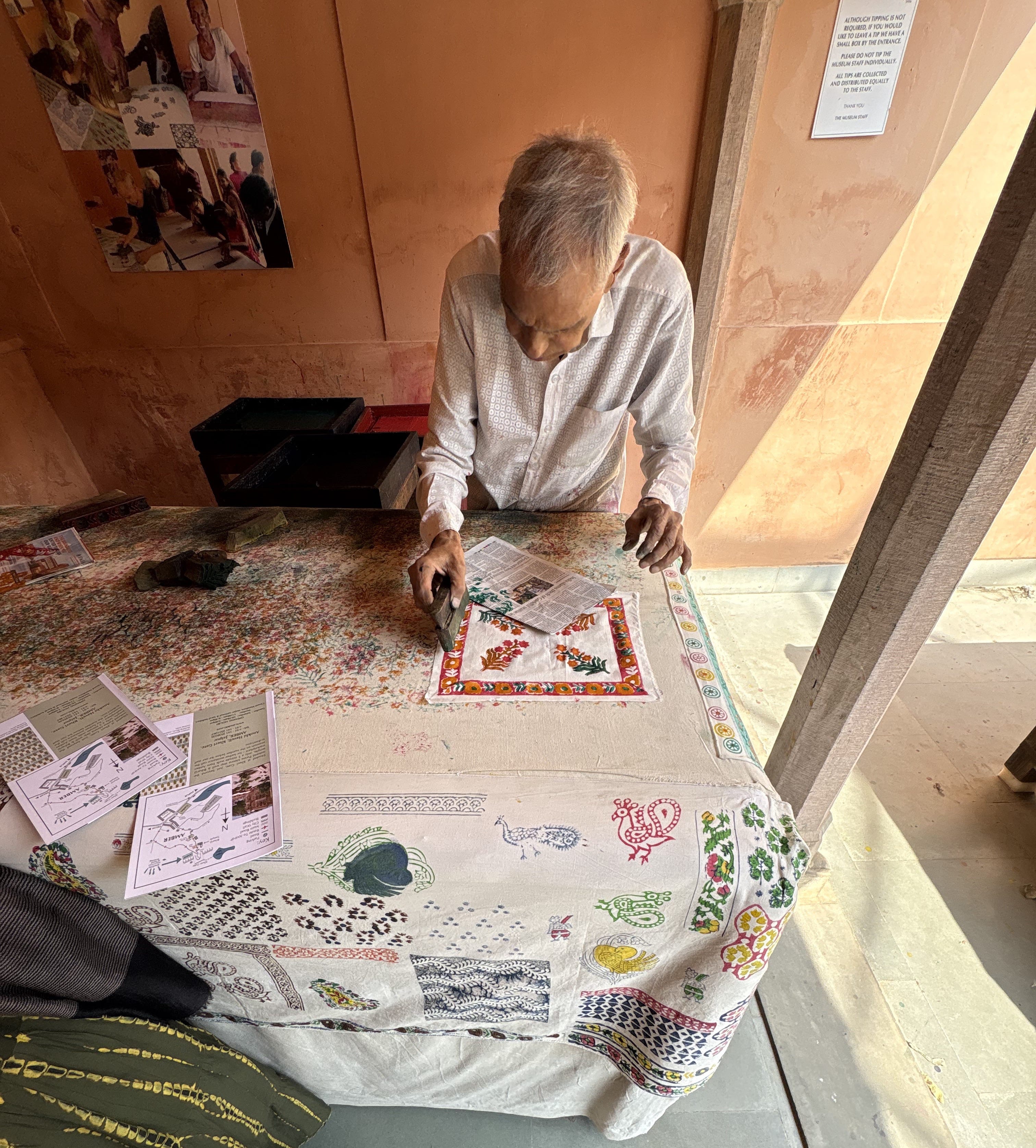
While ironing the cloth at the end, the Artisan made an open-ended remark about how, despite being there throughout the week catering to busy crowds, the visitors are discouraged from tipping them. We tipped him 500 rupees and turned to leave, but he interrupted, asking us to wait before disappearing and reappearing with a couple more painted kerchiefs. Turns out, his current pay is ₹1500 a week; downstairs in the gift shop they were selling a block-printed scarf for ₹3000. The Artisan touched each of our heads, blessing us before bidding farewell.